JavaScript_course
Variables
Variable is like a glass of water that you can put/take something into/from it and use it when you need it. So basically data can be stored in variables.
How to declare a variable?
Before you can use a variable, your need to announce that you want to use it. This involves creating the variable and giving it a name. In programming world they call it variable declaration.
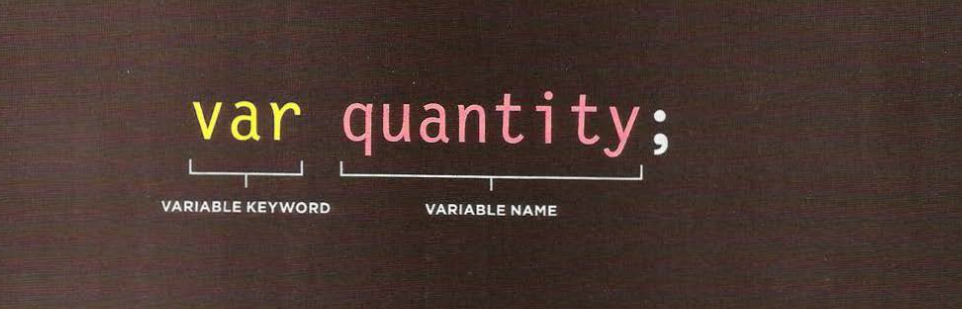
You can declare and assign value at the same time

Rules for naming variables
- Variable name begin with a letter, dollar sign ($), or underscore (_). It must
NOTbegin with a number. - The name can contain letters, numbers, dollar sign ($), or an underscore (_). Note that you must not use a dash(-) or a period (.) in a variable name.
- You cannot use
keywordsor reserved words. for examplevar. - All variables are case sensitive.
Case-Sensitivewhich mean thatfirstnameis not equal tofirstName. - Use a name that describes the kind of information that the variable stores.
- If your variable name is made up of more than one word, use either
camel-caseorsnake-case
Can you specify the valid variable names:
| Variable name | Is Valid |
|---|---|
| firstName | Yes |
| Var# | No |
| first_name | Yes |
| num1 | Yes |
| first name | No |
| first-name | No |
| 1number | No |
| $result | Yes |
Variable data types
JavaScript distinguishes between numbers strings, and true or false values known as Booleans, Functions, Arrays, Objects.
For now we will see only 3 major type which are strings,numbers,boolean.
let variableNumber = 0.75;
let variableString = "I love JS!";
let variableBool1 = true;
let variableBool2 = false;
Ahmed write them c02/js/numeric-variable Program
Ahmed write them c02/js/string-variable Program
Ahmed write them c02/js/string-with-quotes Program
Ahmed write them c02/js/boolean-variable Program
Ahmed write them c02/js/shorthand-variable Program
Ahmed write them c02/js/update-variable Program
Using quotes inside a string
Sometimes you will want to use a double or single quote mark within a string. and this will related to the internal string.
In ES6 there is a special string forming called the back tick which is used to set variables in between string without using + to concatenating stings
References and Terms:
:information_source: Read more about Camel case
:information_source: Read more about Snake case